Lesson 7: Sixteenth-note Grooves
When you play sixteenth notess on the hi-hat, you often need to employ a single stroke roll technique in order to play the notes fast eniugh. This in turn changes the way your hands play the other parts of the drum kit.
When you play eighth notes, you only need to use your right hand, and you play 1 + 2 + 3 + 4 +, and so on. But now there are twice as many notes, so you need to ADD these other notes with your LEFT hand... these will be all the "a's" and "e's". This means you are effectively playing a constant single stroke roll on the hi-hats. Now, the question arises, how do you play other parts of the drum kit if both your hands are tied up on the hi-hat?
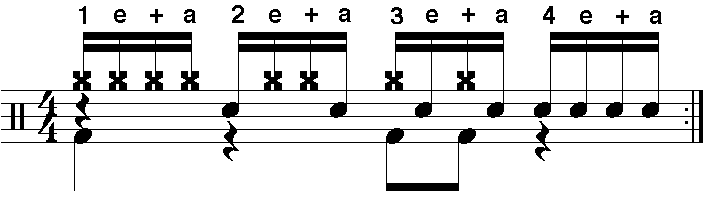
The answer is that you move whichever hand is in time over to the instrument you want to play, and use that hand to play it. The most common instance of this is when you need to play the snare drum on the backbeat. When you are playing just eighth notes on hi-hat, your left hand is free to play all the snare drum notes by itself. However, with sixteenth notes, your left hand would be playing the hi-hat just one sixteenth before and after the backbeat - and unless you have a very fast left hand. it's going to be hard to play three notes in a row. So, you just move your right hand over to the snare drum instead, and you don't play the hi-hat on the backbeat at all. Here's the same backbeat you learnt in Lesson 3, except this time it's got sixteenth notes on the hi-hat. Click on the score, and follow as you listen...
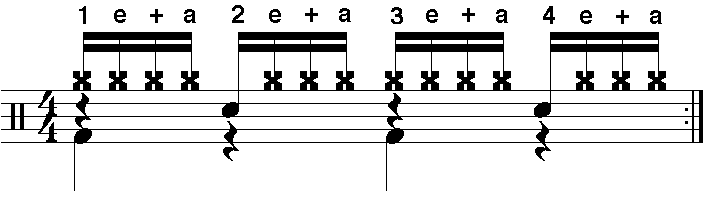
So if we say that the 1 + 2 + 3 + 4 + are "right hand strokes", and all the e's and a's are "left hand strokes", you can easily determine which hand to use, as long as you are counting! You can use this to play any note on any of the instruments in the drum kit, while you are in a "right-hand led" single stroke roll.
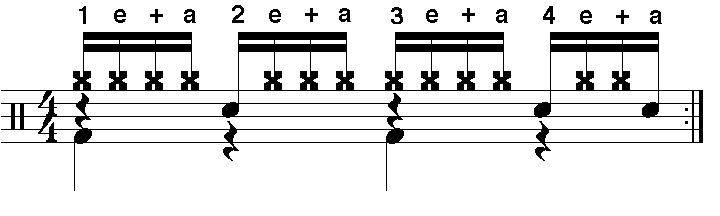
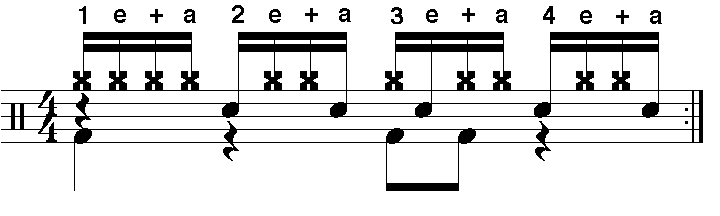
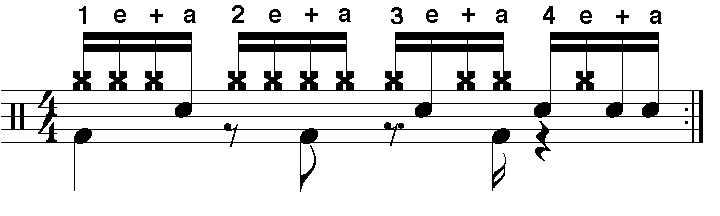
Here are four more grooves from Lesson 6 to try with sixteenth hi-hats
Lesson 1: Basics of Music Theory
Lesson 2: Parts of the Drum Kit
Lesson 3: Basic Techniques of Drumming
Lesson 4: Basic Drum Kit Technique
Lesson 5: Reading Drum Score
Lesson 6: Eighth-note Grooves
Lesson 7: Sixteenth-note Grooves
Lesson 8: Mixing It Up COMING SOON!
Lesson 9: Tricks and Tips COMING SOON!
5.2.3.1 - d-Wizz' Online Academy of Membranophonic Instruction Main Page
5 - d-Wizz Services
0 - Main Page
Lesson 8: Mixing It Up COMING SOON!
Lesson 9: Tricks and Tips COMING SOON!
5.2.3.1 - d-Wizz' Online Academy of Membranophonic Instruction Main Page
5 - d-Wizz Services
0 - Main Page